
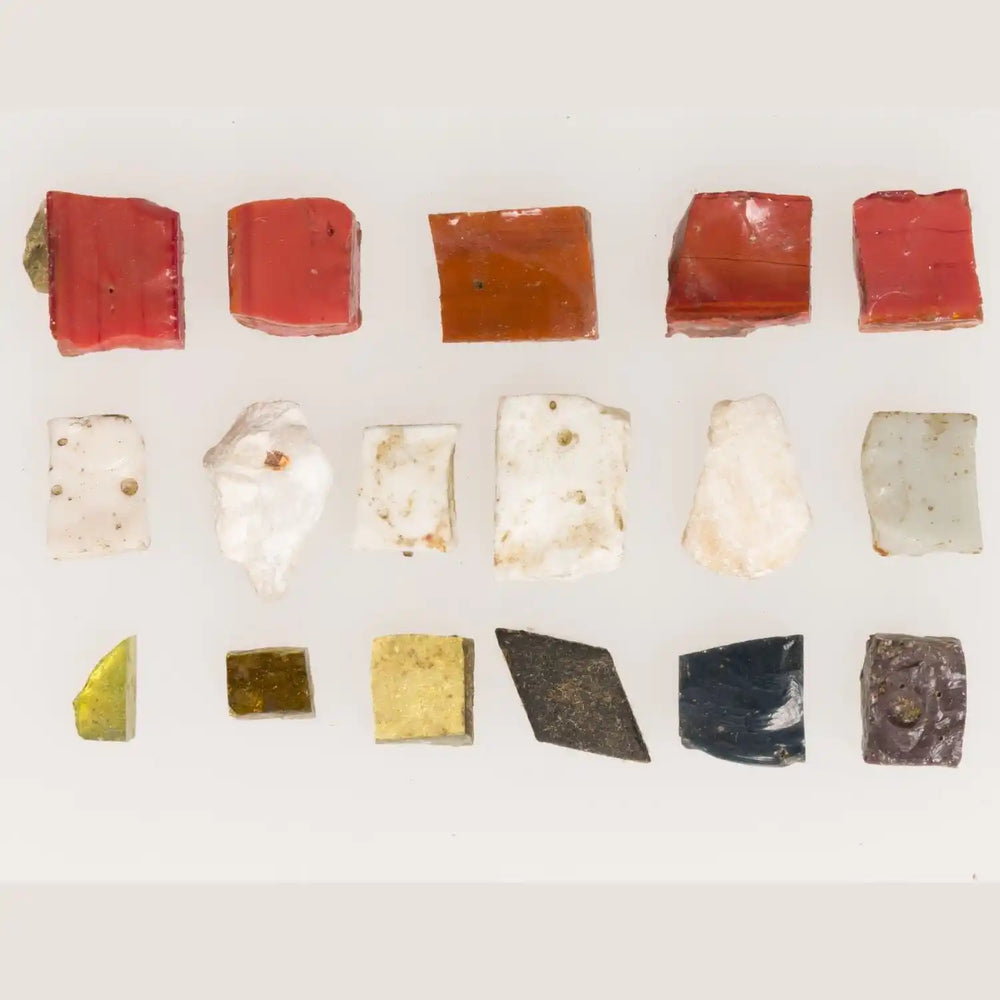
What is mosaic art? Mosaic art is the craft of turning small pieces of glass, stone, ceramic, shell, or beads into a larger pattern, image, or functional artwork. Each fragment is called a tessera. Together they form surfaces that can last for centuries, yet the same principles fit comfortably on a tabletop project you finish in one afternoon.
At Pedalisa Art, this ancient technique becomes a hands-on Turkish mosaic lamp experience: you choose colors, set glass by hand on a glowing globe, and leave with a working lamp you made yourself. Whether you are researching mosaic art meaning for school, comparing mosaic vs painting, or searching for mosaic art classes near me, this guide connects history, technique, and real U.S. workshops in one place.
Prefer to start in person? Book a Turkish mosaic lamp workshop or explore our DIY mosaic lamp kits shipped nationwide.
Key Takeaways
- Mosaic art builds images from individual tesserae, not blended paint.
- Turkish mosaic lamps are three-dimensional, illuminated mosaic art you can make in one guided session.
- Pedalisa Art workshops run about 2.5 hours with all materials, tools, and refreshments included.
- Mosaic art kits for adults let you create at home with pre-selected glass and step-by-step instructions.
- Classes are available in Houston, Dallas, Richardson, and other U.S. locations, plus private group events.
What Is Mosaic Art? Simple Definition
What is mosaic art? Mosaic art is a decorative art form made by arranging small pieces of glass, stone, ceramic, shell, or beads, called tesserae, onto a surface to create a pattern, image, or functional object. Unlike painting, mosaic art is built piece by piece, giving it texture, durability, and light-reflecting depth.
Mosaic art is any design made by placing many small colored pieces side by side until they form a larger whole. The pieces can be square glass tiles, irregular stone fragments, ceramic shards, or delicate beads. What defines the medium is intentional assembly: every tessera is chosen and placed by hand or with guided tools.
That definition covers Roman villa floors, Byzantine church walls, public murals, and the curved glass globes of Turkish mosaic lamps. If you can name a material and stick it to a surface in a pattern, you are working in the mosaic tradition.

Turkish Mosaic Lamps: A Living Mosaic Tradition
Are Turkish mosaic lamps real mosaic art? Yes. Turkish mosaic lamps are a form of mosaic art because they use hand-placed glass tesserae and beads on a three-dimensional glass globe. The direct mosaic method creates a functional artwork that glows when illuminated.
Long before mosaic art became a trendy date-night activity, Ottoman glass workshops in Istanbul adapted centuries of Byzantine glasswork into illuminated globes for palaces and homes. Artisans used the direct mosaic method: tesserae glued face-up on a clear glass form, then finished so light passes through stained glass rather than reflecting off paint.
Today every authentic Turkish mosaic lamp at Pedalisa Art follows that lineage. Colors carry Anatolian symbolism, turquoise for protection, amber for warmth, ruby red for celebration, and geometric star patterns echo Islamic design principles of order and infinity. When the lamp is switched on, the room fills with jewel-toned light. That is mosaic art you live with, not just admire in a museum.

Turkish mosaic lamps bring the ancient mosaic technique into a functional, glowing artwork that beginners can create in a guided workshop. Photo: Pedalisa Art.
Why Turkish Mosaic Lamps Are Different from Flat Mosaics
Wall and floor mosaics are built on flat substrates: cement, wood, or mortar beds that receive tesserae in rows you walk past or look at from a distance. Light usually hits them from outside the surface. The artistry is in color, andamento (row direction), and durability underfoot or on a vertical plane.
A Turkish mosaic lamp is fundamentally different. The substrate is a three-dimensional glass globe. Tesserae wrap a curved form, and the light source sits inside the mosaic. Glass pieces do not only create a surface pattern, they filter and transform light into atmosphere. Turn the lamp off and you see craft; turn it on and you see color in motion across walls and ceilings.
That is why lamp workshops feel so immediate for beginners. You see your pattern glow within minutes of placing the first pieces, something flat mosaics on a table cannot replicate until grout, installation, and external lighting are complete.
Inside a Pedalisa Art Mosaic Lamp Workshop
When you arrive at a Pedalisa Art Turkish mosaic lamp workshop, the session is designed so a first-time maker can finish a complete lamp in one visit. Here is what the experience looks like from start to finish.
- Choose your lamp style. Pick a globe shape, table, moon, Aladdin, or other silhouettes, and a palette of stained glass colors.
- Plan your pattern. Instructors help you map traditional Turkish motifs on the clear globe before any adhesive goes down.
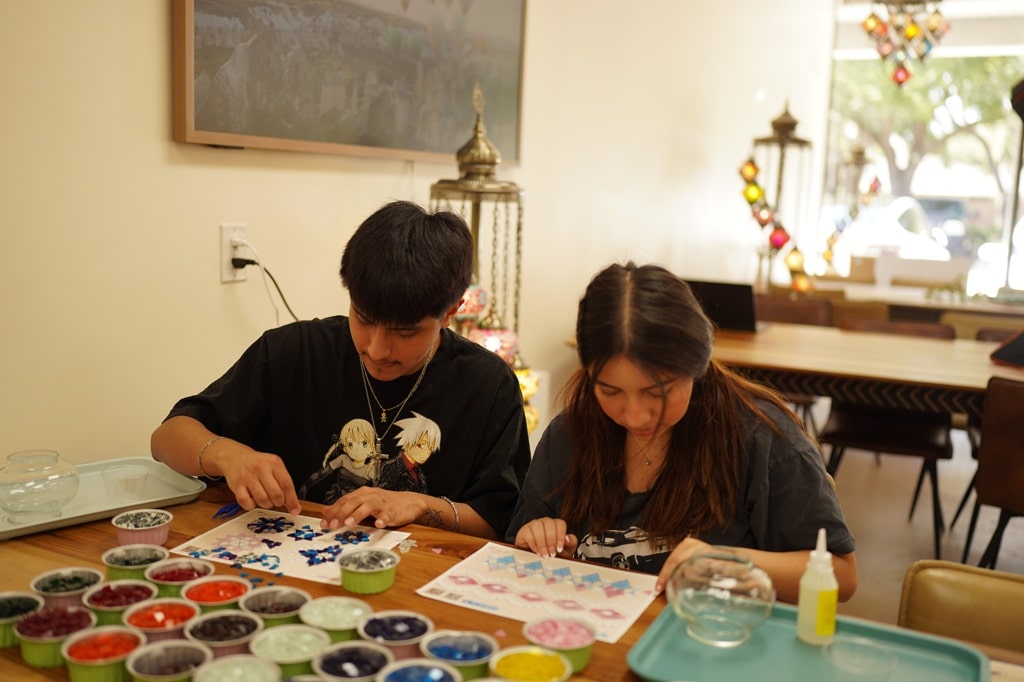
- Set tesserae by hand. You place each glass piece and bead yourself using tweezers and guided spacing; no painting or printing involved.
- Finish and assemble. After adhesive cures, staff help mount the globe on a brass base with working wiring.
- Celebrate with Turkish hospitality. Sessions include Turkish tea, Turkish delight, and baklava during breaks.
The active creative work takes about 2.5 hours. Beginners are welcome; children aged 7 and up often join family sessions. All materials and tools are included, you bring curiosity, not a shopping list.
Watch guests at a Pedalisa Art workshop set stained glass tesserae on a globe and finish a glowing Turkish mosaic lamp in one session.
Ready to experience mosaic art in person?
Join a Pedalisa Art Turkish Mosaic Lamp Workshop and create your own glowing handmade lamp in one guided session.
Book a Workshop Houston WorkshopMosaic Art vs Painting: What Makes It Different?
Is mosaic art the same as painting? No. Painting blends pigment on a flat surface in layers. Mosaic art assembles separate tesserae that each reflect light independently, creating physical texture, shadow lines between pieces, and long-term durability paint cannot match on its own.
People sometimes ask about mosaic painting, either decorative paint applied to tiles to look like mosaic, or the broader question of how mosaic art compares to fine art painting. True mosaic art never relies on a single continuous pigment layer. Each tessera remains a distinct object with its own edge, angle, and refractive quality.
That difference matters for durability and light. A painted mural can fade or peel; a well-set glass mosaic can last millennia. A painted surface reflects light uniformly; mosaic surfaces shimmer because each piece catches light differently. If you want to understand the medium quickly, visit a Turkish lamp making class and watch color change the moment the globe is illuminated.
What Is a Mosaicist?
What is a mosaicist? A mosaicist is a designer and maker who plans and assembles mosaic art from tesserae. The role includes material selection, pattern layout, cutting glass or stone, setting pieces in adhesive or mortar, and finishing with grout or fill between tesserae.
The term mosaicist describes anyone who practices the craft professionally or as a dedicated hobbyist, from restorers working on historic church floors to studio artists selling wall panels, to instructors guiding beginners through a mosaic art class in Sugar Land or Dallas. At Pedalisa Art, lead instructors combine Ottoman pattern knowledge with modern teaching methods so guests leave with both a finished lamp and a clear sense of what mosaic art requires.
The Meaning of Mosaic Art
Beyond technique, mosaic art meaning often centers on unity from diversity: many small parts forming one durable whole. The English word mosaic connects to the Greek Museion, a shrine of the Muses, linking the craft to creative inspiration across cultures.
In Turkish lamp tradition, color carries emotional and cultural weight. Blue and turquoise suggest protection; warm ambers and reds evoke hospitality and celebration. Geometric repeats imply infinity and order. When you make a lamp in a workshop, you participate in that symbolic language even if you choose colors purely for your living room.
A Short History of Mosaic Art
Mosaic art history spans roughly five thousand years. The oldest known examples come from Mesopotamia around 3000 BCE, temple walls decorated with colored stones and shell. Ancient Greeks refined pebble pavements into precise tesserae; Romans spread floor mosaics across their empire, many preserved at archaeological sites today.
Byzantine artists developed gold-leaf glass smalti for soaring church interiors. Islamic craftsmen emphasized geometric and floral repeat patterns in mosques and palaces. Ottoman workshops later channeled that glass expertise into illuminated globes, the direct ancestor of modern Turkish mosaic lamps.
In the twentieth and twenty-first centuries, Antoni Gaudí's trencadís in Barcelona, transit murals, and studio revivals kept the medium visible. In the United States, hands-on lamp workshops turned history into something you can touch in an evening, a thread this guide returns to in modern American workshops below.

Image: Roman mosaic floor, Volubilis, Morocco. Photo via Wikimedia Commons (CC BY-SA 2.0).

Photo: Pedalisa Art workshop, Houston / Sugar Land.
Famous Mosaic Art Examples Around the World

Image: Alexander Mosaic (Roman copy, c. 100 BCE). Photo by miriam.mollerus via Wikimedia Commons (CC BY 2.0).
- Alexander Mosaic (Pompeii, c. 100 BCE): More than a million tesserae depict Alexander the Great in battle.
- Standard of Ur (Mesopotamia, c. 2500 BCE): Early narrative inlay with shell and lapis lazuli.
- Ravenna mosaics (Italy): Byzantine masterpieces in San Vitale and other fifth–sixth century monuments.
- Park Güell (Barcelona, Gaudí): Playful trencadís surfaces covered in broken ceramic.
- Grand Central Terminal ceiling (New York): A civic mosaic that defines a public space.
Studying these landmarks clarifies what mosaic art achieves at monumental scale. The same principle, small pieces, carefully placed, also powers a tabletop lamp you finish at a Pedalisa studio. Scale changes; the craft does not.
Main Types of Mosaic Art

Illustration: Pedalisa Art educational graphic.
Art historians often describe classical mosaic art types by technique:
Opus Tessellatum
Uniform square tesserae in straight rows, the workhorse of large Roman and Byzantine background fields.
Opus Vermiculatum
Very small tesserae in curved rows around faces and focal points for fine detail.
Opus Sectile
Custom-cut stone shapes fitted like a jigsaw, common in luxury Roman floors.
Direct-Method Glass Mosaic
Tesserae set face-up on the final surface, including clear glass globes for Turkish lamps.
Modern teachers also group mosaics by material: glass, stone, and ceramic families each behave differently under light and weather. Both classification systems are useful depending on whether you study art history or shop for a DIY mosaic lamp kit.
How to Make a Turkish Mosaic Lamp
The direct method used in Pedalisa workshops follows seven clear stages:
- Choose your palette: Select stained glass colors and a pattern template.
- Plan on the globe: Dry-fit key pieces to preview balance on the curved surface.
- Apply adhesive in sections: Work in manageable areas so glue stays workable.
- Set tesserae and beads: Place each piece with tweezers; fill gaps with smaller glass.
- Cure the adhesive: Allow the globe to set before final fill between pieces.
- Assemble the lamp: Mount the globe on brass hardware with wiring.
- Light it up: Switch on and take home a working mosaic lamp the same day.
For a deeper home-project walkthrough, see our DIY mosaic lamp guide.

The direct method used in Turkish mosaic lamp workshops: tesserae placed by hand on a glass globe, then illuminated from within.
Mosaic Art Materials and Tools
Glass & beads: Stained glass tesserae and Czech glass beads define Turkish lamps. Light passes through color, essential for the glowing effect. Read more about symbolism in mosaic colors.
Stone & ceramic: Marble, pebble, and ceramic tile suit architectural floors and backsplashes with outdoor durability.
Tools: Wheeled glass cutters, tile nippers, tweezers, safety goggles, and grout floats. Pedalisa workshops supply everything; kits bundle the essentials for home makers.

Mosaic Art for Beginners
Can beginners make mosaic art? Yes. Beginners can make mosaic art with a guided class or DIY kit. Turkish mosaic lamp workshops are especially beginner-friendly because the materials, patterns, tools, and step-by-step instruction are provided.
Mosaic art rewards patience more than prior art training. Most first-time makers produce a piece they are proud to display, especially when the project has clear boundaries like a lamp globe rather than an open-ended wall panel.
Three beginner paths:
- Join a guided mosaic art workshop for instructor support and a guaranteed finish in one session.
- Start with a table lamp DIY kit if you prefer home pacing.
- Book a private mosaic workshop for birthdays, bachelorette parties, or corporate team building.
Prefer to create at home?
Explore Pedalisa Art DIY Mosaic Lamp Kits with pre-selected glass pieces, patterns, and step-by-step instructions.
Shop DIY Kits Moon Lamp KitMosaic Art in Modern American Workshops
Mosaic art is no longer confined to historic floors, churches, or museum cases. Across the United States, Turkish mosaic lamp workshops have turned an ancient technique into a social, beginner-friendly activity, date nights, family outings, birthday celebrations, corporate off-sites, and school programs.

Date nights & celebrations
Couples and friends share a creative table, leave with matching or contrasting lamps, and photograph glowing results the same evening.
Team building
Companies book private group events where teams collaborate on pattern and color choices before individual globes come together.
Family creative time
Children aged 7 and up often join parents; instructors adapt pacing so everyone finishes.
Home makers nationwide
Not near a studio? Mosaic art kits for adults ship anywhere in the U.S. with the same glass quality used in classes.

Mosaic Art Classes Near You
Searching mosaic art classes near me or mosaic workshop Houston / mosaic workshop Dallas? Pedalisa Art hosts public sessions across Texas and additional U.S. locations on our central booking page. Houston and Sugar Land sessions are popular for southwest Houston residents; Dallas and Richardson studios serve the DFW metro.
Select a city to book a Turkish mosaic lamp workshop, or browse all locations on our workshop booking page.

Hosting a larger group? Reserve a dedicated room through our private mosaic workshop page for parties, schools, and corporate events.
DIY Mosaic Lamp Kits
Cannot visit a studio this week? Pedalisa Art DIY mosaic lamp kits bundle stained glass tesserae, beads, adhesive, a clear globe, base hardware, and illustrated instructions. Kits suit adults and teens who want the same direct-method experience at kitchen-table pace.
- Table lamp DIY kit: Classic silhouette for bedside or desk.
- Moon lamp DIY kit: Crescent form with dramatic glow.
- Aladdin lamp DIY kit: Iconic curved profile inspired by Ottoman lantern shapes.
- Full DIY collection: Compare all shipped kits in one place.

Frequently Asked Questions
What is mosaic art in simple words?
Mosaic art is decorating a surface by arranging many small pieces, tesserae, into a pattern or picture. Each piece is placed individually, creating texture and durability unlike a single painted layer.
What materials are used in mosaic art?
Glass, stone, ceramic, shell, beads, and mirror are common. Turkish mosaic lamps primarily use stained glass tesserae and Czech beads on a clear globe with specialty adhesive and fill.
What is a mosaicist?
A mosaicist designs and assembles mosaic art: choosing materials, cutting tesserae, setting pieces, and finishing surfaces with grout or fill.
Is mosaic art the same as painting?
No. Painting uses blended pigment on a flat surface. Mosaic art builds from separate pieces that each reflect light on their own edges and faces.
Are Turkish mosaic lamps considered mosaic art?
Yes. They use hand-placed glass tesserae on a three-dimensional illuminated form, the direct mosaic method applied to functional décor.
Can beginners make mosaic art?
Yes. Guided lamp workshops and DIY kits are designed for first-time makers with step-by-step instruction and included tools.
How long does a mosaic lamp workshop take?
Pedalisa Art sessions include about 2.5 hours of active guided work, plus breaks for Turkish tea, Turkish delight, and baklava.
Where can I find mosaic art classes near me?
Browse Pedalisa Art workshop locations for Houston, Dallas, Richardson, and other U.S. cities, or order a DIY kit shipped nationwide.
Can I make mosaic art at home with a DIY kit?
Yes. Shop the DIY mosaic lamp kit collection for pre-selected glass, patterns, and instructions.
What makes Turkish mosaic lamps unique?
Each lamp is hand-set without mass printing. Curved glass, internal light, and individually chosen tesserae make every finished piece one of a kind.
Start Your Mosaic Art Journey
From ancient tesserae to glowing Turkish lamps, you have the context. Now make something with your own hands.