

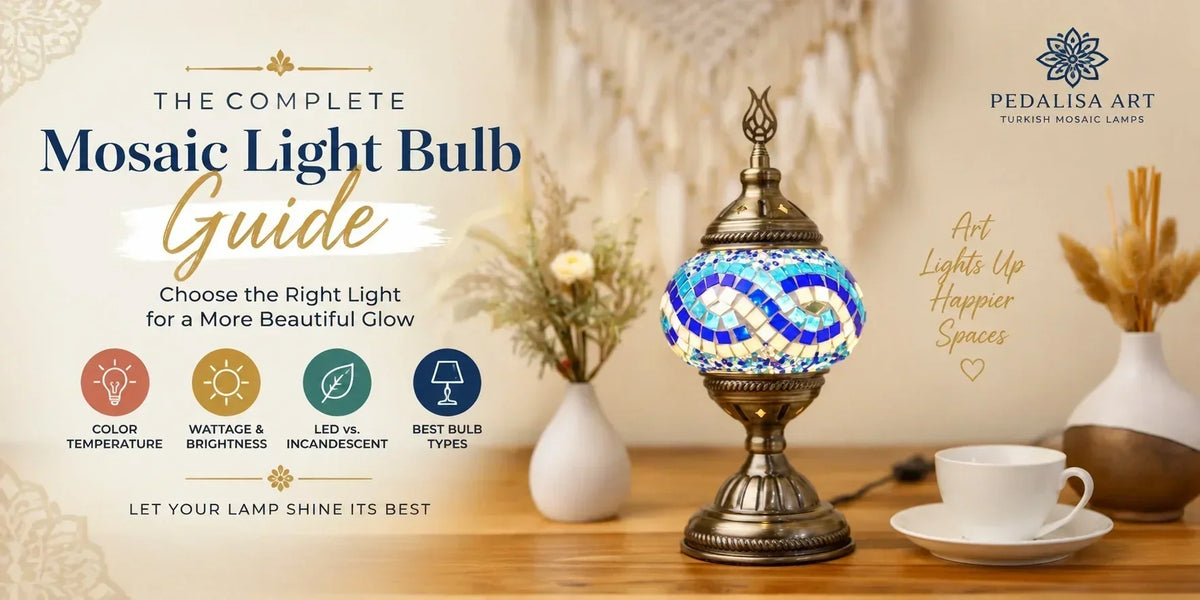
Your Turkish mosaic lamp is only as beautiful as the light inside it. The mosaic light bulb you choose directly shapes how the colored glass glows, which tones radiate warmth, and how the whole room feels after dark. This guide covers everything: color temperature, wattage, bulb shape, and the LED vs. incandescent debate, so your lamp always looks its best.
Mosaic Light Bulb Guide
Color Temperature: The Most Important Factor
Color temperature, measured in Kelvin (K), determines whether your bulb emits warm amber light or cool blue-white light. For a Turkish mosaic lamp, warm light always wins.
2200K–2700K
Warm White / Amber. Ideal for mosaic lamps. Enhances reds, oranges, and golds in the glass.
3000K
Soft White. Works well if your lamp features blues, greens, or purples.
4000K+
Cool White / Daylight. Avoid these. They wash out mosaic colors.
Edison-style filament bulbs at 2200K–2400K are the gold standard for Turkish mosaic lamps. Their organic amber glow deepens every color in the glass and adds to the handcrafted, artisanal character of the piece.

Best Bulb Types for Turkish Mosaic Lamps
Edison Filament Bulbs (Most Recommended)
Vintage-style Edison bulbs with visible filaments produce a warm amber glow (2200K–2400K) that perfectly complements hand-cut colored glass. Look for ST64, G25, or A19 shapes depending on your lamp's socket size. The visible filament also adds to the artisanal aesthetic of the lamp.
Candelabra Bulbs (E12 Base)
Many Turkish table lamps and smaller pendant lamps use an E12 candelabra base. A warm-white candelabra bulb in the 2700K range works beautifully and is available in both incandescent and LED versions at most hardware stores.
Standard LED Bulbs (E26 Base)
For larger Turkish mosaic lamps with a standard E26 socket, a 2700K warm-white LED is an excellent energy-efficient choice. Look for bulbs labeled "warm white" and avoid anything labeled "daylight" or "bright white."
Smart Bulbs (Tunable)
Tunable smart bulbs such as Philips Hue or LIFX let you dial in the exact color temperature. Set them to 2200K–2700K for the best mosaic lamp effect and dim them for a relaxed evening ambiance. Best of all, you can experiment with the glow without changing the bulb.
Wattage and Brightness
Turkish mosaic lamps are designed to diffuse and filter light through colored glass, not to flood a room. Lower wattage always produces the best results.
- Table and accent lamps: 25W–40W incandescent equivalent (4W–6W LED). Bright enough to see the colors clearly, gentle enough to keep the ambiance.
- Pendant and hanging lamps: 40W–60W incandescent equivalent (6W–8W LED), especially if the lamp is the primary light source.
- Decorative display only: 15W–25W equivalent (2W–4W LED) for subtle color effects without strong illumination.
Avoid high-wattage bulbs. Excessive heat stresses the mosaic cement and grout over time, particularly in handmade workshop lamps where the cement is applied by hand and cures after the session.

LED vs. Incandescent for Mosaic Lamps
- Incandescent: Produces the warmest, most natural-looking light. The gentle warmth pairs beautifully with handmade mosaic glass. Drawback: more heat output and higher energy use.
- LED: Energy-efficient, long-lasting, and much less heat output, which is better for lamp longevity. Choose a high-CRI (90+) warm-white LED for the best color rendering through the glass panels.
Our recommendation: Use a warm-white LED with a CRI of 90 or higher. It delivers beautiful color quality through the glass, generates minimal heat, and can last 15,000–25,000 hours, well over a decade of daily use.
Want to See Your Lamp Glow in Person?
The best way to understand how light interacts with Turkish mosaic glass is to build your own lamp and turn it on for the first time. At PedalisaArt workshops, that moment is one of the most rewarding parts of the experience.
Find a Workshop Near YouMosaic Light Bulb FAQ
What size bulb socket does a Turkish mosaic lamp use?
Most Turkish mosaic table lamps use an E26 (standard) or E12 (candelabra) socket. Pendant and hanging lamps typically use E26. Always check your specific lamp's socket before purchasing a bulb.
Can I use a colored bulb in a mosaic lamp?
We do not recommend it. The mosaic glass panels already produce rich, colored light. Adding a colored bulb can muddy the tones or create unnatural combinations. Stick to warm white and let the glass do the work.
How often should I replace the bulb?
A quality warm-white LED lasts 15,000–25,000 hours. With 3–4 hours of daily use, that is 10–20 years between replacements. Incandescent bulbs typically last 1,000–2,000 hours.
Will a bright bulb damage my handmade mosaic lamp?
High-wattage incandescent bulbs generate significant heat, which can stress mosaic cement joints over time. We recommend staying at or below a 40W incandescent equivalent (6W LED) for handmade workshop lamps.
Where can I buy the right bulb?
Warm-white Edison and LED bulbs in E26 and E12 bases are widely available at hardware stores, home improvement retailers, and online. Look for bulbs labeled 2700K warm white with a CRI of 90+.
Experience a Turkish Mosaic Lamp Workshop
Reading about mosaic lamps is one thing. Building one with your own hands and seeing the light come alive through hand-cut colored glass is another experience entirely. At PedalisaArt, our hands-on workshops are held across the United States and are open to all skill levels. No art experience needed.

Light Up Your Space with a Handmade Mosaic Lamp
Build your own Turkish mosaic lamp at a PedalisaArt workshop, or shop our collection of authentic ready-made lamps.